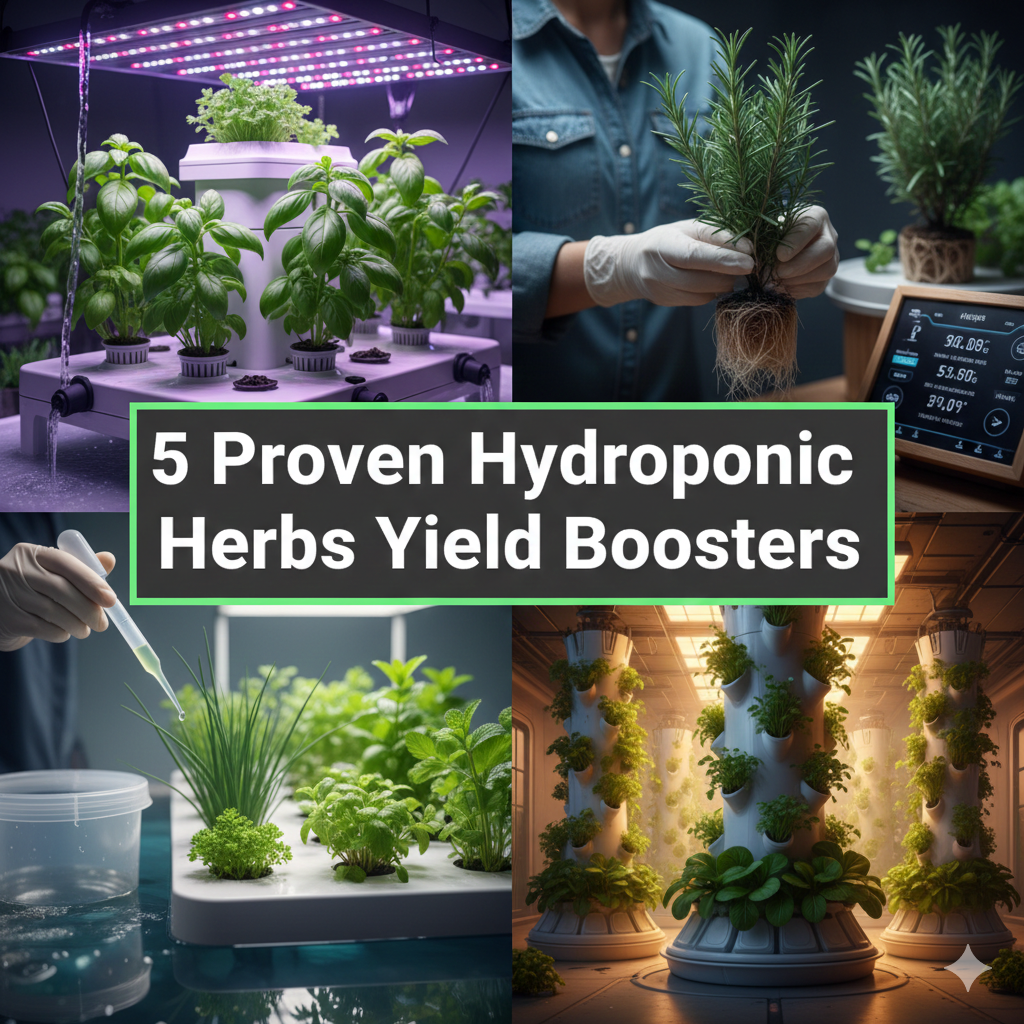
You planted your herbs. You set up your system. But the yields aren’t what you’d hoped for.
Sound familiar?
Herbs are fun to grow hydroponically — no dirt, quicker growth and you can have fresh basil or mint right in your kitchen. But getting big yields? It takes something more than water and seeds.
Hydroponic growers often do things that can really increase how much their herbs produce — and the good news is that these methods have been tested thousands of times with proven results. These aren’t tricks or gimmicks. They’re grounded in plant science and supported by real results.
In this article, you’ll learn about 5 hydroponic herbs yield boosters that actually work — and how to use them.
Why Hydroponic Herbs Sometimes Underperform
Booster shots aside, it’s useful to understand why yields disappoint in the first place.
The same problems afflict most herb growers:
- Wrong nutrient ratios
- Not enough (or too much) light
- Poor air circulation
- Ignoring the root zone
- Harvesting at the wrong time
All of these issues are silently robbing your yield each and every day. Correct them — and your plants can be 50 percent more productive than they are now.
Let’s fix that right now.
Booster #1 — Give Your Plants the Right Nutrients at the Right Time
Why Nutrients Are the Building Blocks of Everything
Nutrients are food for your plants. Without the appropriate food at the appropriate time, they cannot develop properly.
Hydroponic herbs depend completely on you to provide them with nutrients in the water. There’s no soil to absorb mistakes. As such, getting your nutrient ratios right is one of the best yield multipliers you have at your disposal.
The 3 Major Nutrients (And Their Roles)
Three essential nutrients any herb grower must understand:
| Nutrient | Symbol | Function |
|---|---|---|
| Nitrogen | N | Promotes leafy green growth |
| Phosphorus | P | Fuels root development and flowering |
| Potassium | K | Controls water movement, strengthens plants |
You want a higher nitrogen ratio during the vegetative (leaf-growing) stage for most herbs like basil, cilantro, mint and parsley. This is when the plant is putting out new stems and leaves — precisely what you want to harvest.
Why EC Levels Matter More Than You Think
EC stands for Electrical Conductivity. It shows how many nutrients are in your water.
Most herbs grow best at an EC of 0.8–1.6.
Too low? Underfed plants with light green leaves and stunted growth. Too high? Nutrient burn — brown leaf tips and stressed roots.
A cheap EC meter (around $10–$15) can help you dial this in exactly. As a hydroponic grower, this one tool may be the best investment you can make.
Changing Nutrients as Your Plant Matures
Here’s a step that many beginner growers miss: adjusting your nutrient mix as the plant gets bigger.
- Seedling stage: Light nutrient solution, EC around 0.5–0.8
- Vegetative stage: Increased nitrogen, EC 1.0–1.4
- Pre-harvest stage: Slightly less nitrogen, more potassium
This staged feeding tracks the way plants naturally take in nutrients across different stages of life — and it drives yields significantly higher.
Booster #2 — Light Optimization Most Growers Get Wrong
More Light Isn’t Always Better
Light is plant fuel. But just blasting more light on your herbs won’t mean more yield. In fact, excessive light causes stress, bleaching, and slower growth.
The objective is the right kind of light, at the right intensity, for the right duration.
What Research Says About Light Spectrum
Not all colors of light are equally usable by plants. They primarily absorb blue and red wavelengths.
| Light Color | Wavelength | Best For |
|---|---|---|
| Blue | 400–500 nm | Compact, bushy leaf growth |
| Red | 620–700 nm | Stem elongation, flowering |
| Full Spectrum | 400–700 nm | Overall balanced growth |
For the herbs that you harvest for their leaves — basil, mint, chives, parsley — blue light is king. It keeps plants stocky and promotes thick, tasty foliage.
Full-spectrum LED grow lights cover both ranges and are nowadays the standard choice for hydroponic herb setups.
Daily Light Integral (DLI) — The Number You Need to Track
DLI stands for Daily Light Integral — the total amount of light a plant gets in a 24-hour period. It’s a combination of the intensity of the light and how many hours it runs per day.
Most culinary herbs grow very well with a DLI of 12–20 mol/m²/day.
A simple way to hit this:
- Set your grow lights to run for 14–16 hours a day
- Maintain LED panels 6–12 inches above the canopy (consult manufacturer specs)
- Use a timer to stay on track and adhere to the schedule
It matters as much about consistency as it does about intensity. Fluctuating light disrupts plant hormone cycles and lowers yield.
Don’t Underestimate Reflective Surfaces
Here is a simple, inexpensive trick that can increase light efficiency by as much as 30 percent: reflective walls.
White walls or mylar sheeting reflects unused light back towards your plants. In a small grow tent or cabinet, it can significantly enhance canopy coverage without purchasing higher-power lights.
Booster #3 — Root Zone Health Is Your Secret Weapon
What Lies Beneath Dictates What Flourishes Above
Most growers are obsessed with leaves and stems. But the real action is all in the root zone.
Healthy roots are white, firm, and fuzzy with root hairs. Roots that are unhealthy look brown and slimy and smell bad. If your roots are failing, your yields fail — no matter what you do above the water line.
The Most Neglected Yield Booster: Dissolved Oxygen
Plant roots need oxygen. In soil, they get it from air pockets between soil particles. With hydroponics, you have to deliver it into the water.
This is called Dissolved Oxygen (DO), and most beginning growers totally overlook it.
Target DO level: 7–10 mg/L
How to boost dissolved oxygen:
- Air stones and air pumps — the cheapest and most widely used option
- Water chillers — cold water holds more oxygen (keep reservoir at 65–68°F)
- Deep Water Culture (DWC) systems with robust aeration integrated
Roots submerged in poorly oxygenated water become anaerobic — that is, they begin to rot. This is called root rot, and it’s among the top yield killers in hydroponics.
Beneficial Bacteria and Mycorrhizae
This one catches a lot of growers by surprise: using beneficial microbes in your reservoir can really increase yields.
Products containing Bacillus subtilis or mycorrhizal fungi create a microbial shield around your roots. They:
- Fight off root rot pathogens
- Aid roots in nutrient absorption
- Stimulate faster root development
Look for hydroponic-safe products that list these beneficial organisms on the label. A small dose every week in your reservoir goes a long way.
Root Zone Temperature Matters
Maintain your reservoir water at 65–72°F (18–22°C).
Warmer water holds less oxygen and becomes a refuge for harmful bacteria. Colder water is safer — but if it’s too cold, nutrient uptake decreases.
You can easily monitor this using a simple aquarium thermometer.
Booster #4 — Strategic Pruning and Harvesting Techniques
Cut Your Plants to Get More — Not Less
This might seem counterintuitive, but it’s one of the most reliable hydroponic herbs yield boosters out there.
When you prune properly, you signal the plant to branch out and produce additional growth points. More growth points = more material to harvest over time.
If you’re looking to explore more herb growing tips and plant care guides, The Herb Garden is a great resource to bookmark.
The Topping Technique for Bushy Herbs
Topping means cutting off the main growing tip of the plant.
When you cut the top off, the plant funnels its energy into two or more side shoots. Those side shoots develop into new stems — each one able to yield harvestable leaves.
How to top your herbs:
- Wait until the plant has 4–6 sets of leaves
- Always use clean scissors and cut just above the 3rd or 4th leaf node
- Within 5–7 days, you will have two new shoots emerging
Continue this as the plant matures and you will end up with a bushy herb plant with double or triple the harvest area.
Harvesting: The “Never Strip” Rule
Do not harvest more than one-third of the plant at once.
Removing too much at a time stresses the plant, and regrowth slows significantly. Follow the one-third rule and your plant continues to produce rapidly and consistently.
Harvest at the Right Time of Day
Yes, when you harvest makes a difference.
Herb harvesting is best done in the morning, after grow lights have been on for 1–2 hours. This is the time when essential oils, flavor compounds, and moisture levels are at their peak inside the plant tissue.
Herbs harvested at this time also store better and taste stronger.
Pruning for Airflow
Don’t just prune for yield — prune for airflow too.
Thick, overlapping leaves create pockets of humidity that encourage mold and fungal issues. Removing a few interior leaves increases airflow and promotes a healthier canopy.
Booster #5 — Environmental Control: Temperature, Humidity, and CO₂
Your Growing Environment Is Supporting You or Sabotaging You
Even if you are nailing nutrients, light, and root health — a poor environment will cap your yields.
The atmosphere surrounding your plants governs how quickly they photosynthesize, how efficiently they absorb nutrients, and how resilient they are to pests and disease.
Ideal Temperature Ranges for Hydroponic Herbs
| Herb | Day Temp (°F) | Night Temp (°F) |
|---|---|---|
| Basil | 70–80 | 60–65 |
| Mint | 65–75 | 55–65 |
| Cilantro | 60–75 | 55–60 |
| Parsley | 65–75 | 55–65 |
| Chives | 60–70 | 50–60 |
A 10°F nighttime temperature drop (known as a temperature differential or “night drop”) is actually beneficial. It imitates natural conditions, slows respiration, and gives the plant time to recover and redirect nutrients into new growth.
Humidity: Staying in the Sweet Spot
Too humid = mold, mildew, and fungal disease. Too dry = stressed plants with poor nutrient uptake.
Ideal humidity range for most herbs: 50–70% RH
Monitor this using a hygrometer (humidity meter). Adjust with:
- A humidifier if the air is too dry
- A dehumidifier or better ventilation if the air is too humid
Air Circulation Is Non-Negotiable
Stagnant air is yield’s enemy.
A gentle oscillating fan circulates air over your canopy. This does three things:
- Strengthens stems through gentle mechanical stress (called thigmomorphogenesis)
- Reduces hot spots and humidity pockets
- Helps CO₂ reach plant leaves more efficiently
Even a small clip-on fan makes a real difference in a grow tent or indoor setup.
CO₂ Enrichment — The Advanced Yield Booster
Plants use CO₂ (carbon dioxide) to photosynthesize. Its normal concentration in the air is about 400 ppm (parts per million).
Boosting CO₂ levels to 800–1,200 ppm in a sealed grow room can increase growth rates by 20–30% in high-light environments.
This is an advanced technique. It only works if your light levels are also high enough to support faster photosynthesis. Combined, elevated CO₂ and optimized lighting create a significant yield multiplication effect.
According to research published by the University of Arizona’s Controlled Environment Agriculture Center, CO₂ enrichment combined with optimal lighting and nutrition can produce measurable improvements in both plant biomass and essential oil content in leafy herbs.
How These Five Boosters Work Together
Here’s the most important insight that nearly every grower misses: these five strategies compound.
Every booster makes the others even more effective.
Better nutrients → healthier roots → more efficient use of light → faster growth → more to harvest.
Think of it like a chain. Strengthening every link makes the whole system dramatically more productive.
Here’s a quick reference summary:
| Booster | Primary Benefit | Difficulty Level |
|---|---|---|
| Nutrient Optimization | Fuels faster, denser growth | Beginner |
| Light Optimization | Maximizes photosynthesis | Beginner–Intermediate |
| Root Zone Health | Prevents yield loss from root problems | Intermediate |
| Pruning & Harvesting | Increases harvestable material | Beginner |
| Environmental Control | Optimizes growing conditions | Intermediate–Advanced |
Begin with the beginner-level boosters and, as your confidence grows, layer in the more advanced strategies.
A Realistic Timeline: What to Expect
A question every grower has asked at some point is: How soon will I see results?
Here’s a realistic breakdown:
Week 1–2: Early signs of nutrient and light adjustments — leaves become brighter in color, new growth comes faster
Week 3–4: Pruning effects kick in — side shoots growing, canopy getting bushier
Week 5–8: Root zone improvements become visible — increased growth rates, bigger harvests per cutting
Week 8+: Environmental control optimizations accumulate — consistent, high-yielding harvests with minimal losses
Part of the process is having patience. However, growers who implement all five of these hydroponic herbs yield boosters routinely report 40–80% higher yields than their baseline within two to three grow cycles.
FAQs About Hydroponic Herbs Yield Boosters
Q: Which herb gives the best yield in hydroponics?
Basil and mint are consistently the highest-yielding herbs in hydroponic setups. They respond very favorably to being pruned and topped, and they grow fast under artificial lighting. In an optimized system, basil in particular can be harvested every 1–2 weeks.
Q: Is it necessary to invest in costly equipment to boost hydroponic herb yields?
Not at all. Many of the best yield boosters — such as proper pruning, adjusting nutrient EC, and adding an air stone — don’t cost much at all. An EC meter, a pH meter, a basic air pump, and a reliable timer are the core tools that give you the most bang for your buck.
Q: When should I change my nutrient solution?
For most herb setups, do a full reservoir change every 7–14 days. Add plain pH-balanced water as levels drop between changes. Over time, nutrient ratios fall out of balance because plants are always preferentially absorbing certain elements — a fresh reservoir keeps everything dialed in.
Q: Is it safe to use tap water in my hydroponic herb system?
You can, but it depends on your tap water quality. Excess amounts of chlorine or chloramines can harm beneficial microbes and hinder plant health. Leave tap water in an open container for 24 hours to off-gas chlorine, or use a basic carbon filter. Always check and adjust pH after adding nutrients — aim for 5.5–6.5 for most herbs.
Q: Is CO₂ supplementation safe for indoor grows?
Yes, when used responsibly. Keep CO₂ levels below 1,500 ppm — above that, it can become harmful to humans in enclosed spaces. Always maintain proper ventilation when using CO₂ enrichment systems, and use them only after your lighting and nutrient systems are already running optimally.
Q: Why are my hydroponic herb leaves turning yellow?
Yellow leaves often indicate a nitrogen deficiency, a pH imbalance that blocks nutrient absorption, or root problems. Check your EC level (may be too low), then check your pH (should be 5.5–6.5), and finally inspect your roots for signs of rot. Resolving these in that order often fixes the problem quickly.
Wrapping It All Up
Hydroponic herb gardening is inherently rewarding, fast, and productive — when you know which levers to pull.
These 5 proven hydroponic herbs yield boosters detailed in this article aren’t rocket science. They are logical, science-based practices that work with — rather than against — how plants grow naturally.
To summarize what you’ve learned:
- Feed wisely — adjust nutrients to your plant’s stage of growth
- Light right — use the right spectrum, duration, and intensity
- Protect your roots — oxygenate, use beneficial microbes, and control temperature
- Prune strategically — top your plants and follow the one-third harvesting rule
- Control your environment — temperature, humidity, airflow, and CO₂
You don’t need to implement all of this at once. Choose one booster, apply it, and see what happens. Then layer in the next.
Incremental improvements compound on one another to yield big results. That’s how the finest hydroponic herb growers are able to reliably pull fantastic yields from even small setups.
Now go grow something great.