
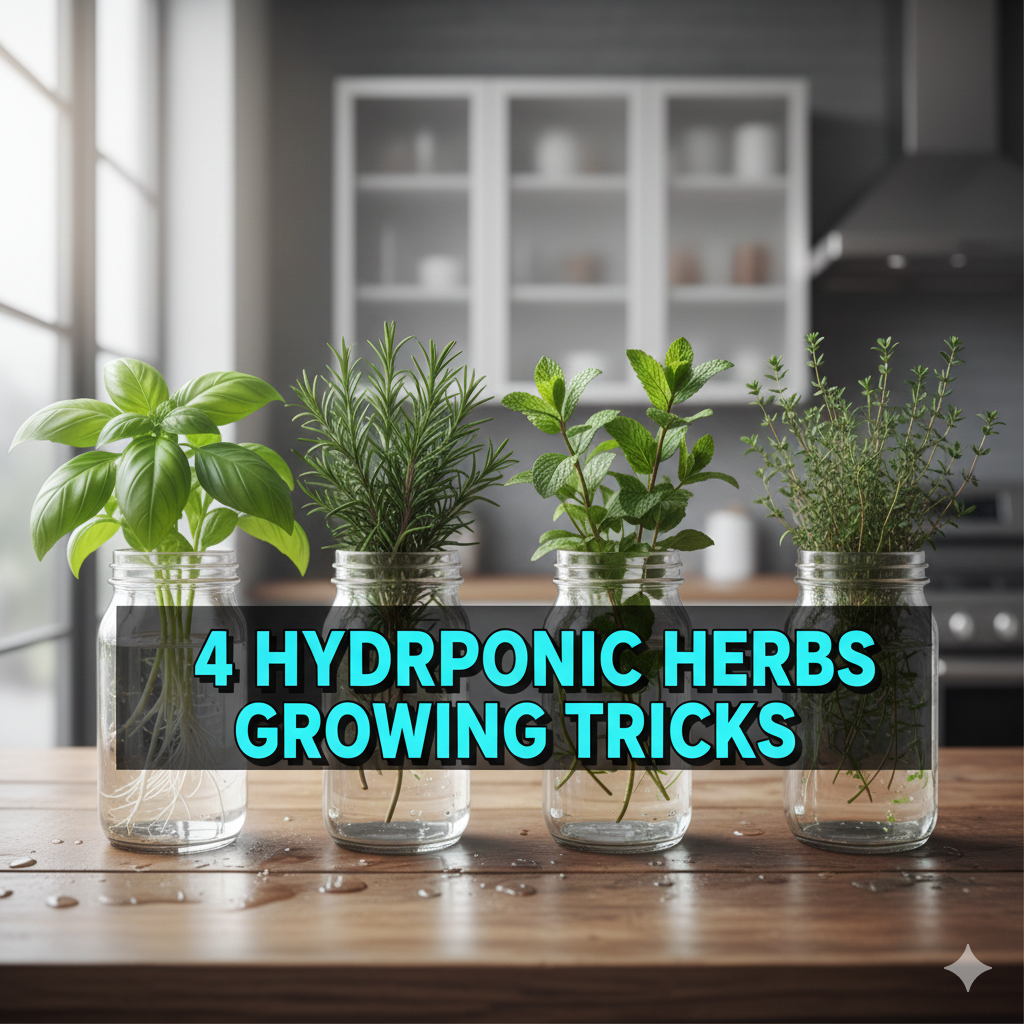
Imagine entering your kitchen and snipping fresh basil, mint, or parsley from your own home garden. No grocery store run. No limp herbs from a plastic pack. Just bright, lush flavor — just when you need it.
That’s precisely what hydroponic herb growing allows.
But here’s something most guides aren’t going to tell you: not all hydroponic setups grow at the same speed. Some herbs shoot up in weeks. Others drag along for months. The difference is nearly always down to a handful of savvy, targeted tricks that most beginners just don’t know exist.
Here’s a breakdown of 4 fast hydroponic herbs growing tricks that can really speed up the process. These aren’t complicated techniques reserved for veteran growers. They’re practical, field-tested methods that anyone — even a total novice — can implement immediately.
Ready to grow faster, harvest sooner, and get more out of every plant? Let’s get into it.
Why Speed Matters in Hydroponic Herb Growing
Before diving into the tricks, it’s useful to know why growth speed is such a big deal in the first place.
When you grow herbs hydroponically, you’re already one step ahead. Nutrients go directly to the plant roots without any searching required, which is why hydroponic plants grow up to 50% faster than their soil-grown counterparts.
But “faster than soil” isn’t always fast enough. If your setup isn’t dialed in, you could still be waiting six to eight weeks for a decent harvest. A well-tuned system, on the other hand, can get you there in half that time.
Speed also affects flavor. Herbs that grow quickly under the right conditions produce higher amounts of aromatic oils. Those oils are what give basil its basil smell and mint its mint scent. Slow, stressed plants tend to taste flat and weak.
So accelerating your growth isn’t simply about impatience. It’s about better-tasting herbs, more often.
If you want to explore even more about growing herbs at home, The Herb Garden is a fantastic resource packed with beginner-friendly guides and tips for every level of grower.
A Quick Look at Herb Growth Rates in Hydroponics
Before getting into the tricks, here’s a baseline comparison of how fast common herbs grow hydroponically versus in soil.
| Herb | Soil Growth (Days to Harvest) | Hydroponic Growth (Days to Harvest) | Speed Difference |
|---|---|---|---|
| Basil | 60–90 days | 25–35 days | ~60% faster |
| Mint | 70–90 days | 20–30 days | ~65% faster |
| Cilantro | 50–70 days | 30–40 days | ~40% faster |
| Parsley | 70–90 days | 35–45 days | ~50% faster |
| Chives | 60–80 days | 30–40 days | ~45% faster |
| Dill | 40–60 days | 25–35 days | ~40% faster |
| Oregano | 80–90 days | 40–55 days | ~45% faster |
| Watercress | 50–60 days | 15–20 days | ~65% faster |
These numbers are averages. With some clever tricks applied, you can nudge your herbs further toward the faster end of those ranges — and in some cases past them.
Trick #1 — Be a Light-Schedule Pro
If there’s one single factor responsible for how quickly your hydroponic herbs grow, it’s light. Not nutrients. Not water. Light.
Photosynthesis is how plants make energy from light. More light — at the right intensity and the right spectrum — means more energy. More energy means faster and stronger growth.
Most beginners set up a grow light, turn it on, and consider themselves finished. That method works, but it leaves a lot of speed on the table.
The Magic of the 18/6 Light Cycle
For most leafy herbs, an 18-hour light / 6-hour dark cycle is the sweet spot for maximum growth speed. During the light period, the plant photosynthesizes and builds energy. During the dark period, it uses that energy to form new cells.
Skipping the dark period entirely — running lights 24 hours — actually slows growth for most herbs. Plants need that rest window. It’s kind of like sleep for humans. Without it, performance drops.
Light Schedule Comparison for Herbs
| Light Schedule | Growth Speed | Notes |
|---|---|---|
| 12 on / 12 off | Slow | Not enough light for most herbs |
| 14 on / 10 off | Moderate | Good for low-light herbs |
| 16 on / 8 off | Good | Works well for most herbs |
| 18 on / 6 off | Best | Ideal for fast-growing herbs |
| 24 on / 0 off | Mixed | Can cause stress and slow growth |
Set a timer and stick to it. Consistency matters just as much as the number of hours.
Choosing the Right Light Spectrum
Not all light is equal. Plants respond differently to different colors of light.
Blue light (400–500 nm) promotes leafy, compact growth. It’s what you want most for herbs since you’re harvesting the leaves.
Red light (600–700 nm) encourages overall plant development and accelerates the growth cycle.
A full-spectrum LED grow light covering both blue and red wavelengths gives your herbs exactly what they need to grow vigorously and bushy. For herbs, look for full-spectrum lights with a color temperature between 4000K and 6500K.
Light Intensity and Distance
Getting the right spectrum is only half the battle. The light also needs to be close enough to actually deliver that energy.
For most herbs, LED grow lights should be placed 12 to 24 inches above the plant canopy. Too far away and the light disperses, losing intensity. Too close and you risk light burn on the foliage.
A quick check: if your herbs are growing tall and reaching toward the light source, move the light closer. If leaf tips are browning or bleached, move it farther away.
Trick #2 — Dial In Your Nutrient Mix for Explosive Leaf Growth
Here’s something that surprises a lot of new growers: more nutrients does not mean faster growth.
In fact, giving your herbs too much fertilizer is one of the most common mistakes in hydroponic herb setups. Excess fertilizer causes nutrient burn — crispy brown leaf tips that signal the plant is being overwhelmed.
The goal isn’t maximum nutrients. It’s the right nutrients at the right concentration for the specific stage your herb is in.
Growth Stages and What Your Herbs Need
Herbs go through two main phases: seedling/vegetative and mature/pre-harvest. Each phase has different nutritional needs.
| Growth Stage | Key Nutrients | EC Range | pH Range |
|---|---|---|---|
| Seedling (Week 1–2) | Low N, Low P, Low K | 0.8 – 1.2 | 5.5 – 6.0 |
| Early Vegetative (Week 2–4) | Higher N, Moderate P & K | 1.2 – 1.8 | 5.8 – 6.3 |
| Full Vegetative / Pre-Harvest | High N, Moderate P & K | 1.8 – 2.4 | 6.0 – 6.5 |
EC stands for Electrical Conductivity. It measures how concentrated your nutrient solution is. A basic EC meter costs just a few dollars and is one of the best investments you can make for your hydroponic herb setup.
The Nitrogen Advantage
For leafy herbs, nitrogen (N) is the powerhouse nutrient. It’s directly responsible for leaf production and green color. When nitrogen levels are right, herbs grow fast, full, and flavorful.
Signs of too little nitrogen: pale yellow leaves, slow growth, weak stems.
Signs of too much nitrogen: very dark green leaves, soft and floppy stems, possible root issues.
The ideal nitrogen-to-potassium ratio for fast-growing leafy herbs is roughly 3:1. Most quality hydroponic nutrient solutions formulated for leafy greens will already reflect this.
Change Your Reservoir Regularly
Old nutrient solution slows growth. Over time, nutrients are absorbed unevenly. Some build up while others get depleted. This imbalance slows growth and can cause deficiencies even when nutrients are technically present.
Change your reservoir completely every 7 to 14 days. Between changes, top up with plain, pH-adjusted water to maintain the level.
This single habit alone can noticeably speed up your herb growth.
Trick #3 — Tap Into Root Zone Optimization for Hidden Speed
Most growers focus almost entirely on what’s happening above the water line. Leaves, stems, light exposure. But here’s the hard truth — your herbs grow only as fast as their roots allow.
The root zone is where everything happens. It’s where water and nutrients enter the plant. If the roots are unhappy, growth slows down no matter what you do up top.
Optimizing your root zone is one of the most overlooked fast hydroponic herbs growing tricks out there.
Keep Your Water Temperature Dialed In
This is critical and often ignored. The ideal water temperature for hydroponic herb roots is 65°F to 72°F (18°C to 22°C).
Warm water — above 75°F — holds significantly less dissolved oxygen. Less oxygen means slower root function and a much higher risk of root rot. Root rot can devastate a plant in just a few days.
Cool water — below 60°F — slows down nutrient absorption and root metabolism. Growth comes to a crawl.
Invest in an aquarium thermometer to keep track. If your reservoir runs warm, consider wrapping it in reflective insulation or placing it in a cooler spot.
Oxygen Is a Growth Accelerator
Roots don’t just absorb nutrients. They breathe. Oxygen in the root zone dramatically speeds up nutrient uptake and overall plant metabolism.
According to the University of Minnesota Extension, adequate oxygenation in hydroponic systems is one of the most critical factors for healthy root development and fast plant growth.
In a Deep Water Culture (DWC) setup, an air pump with an air stone keeps the water oxygenated. Run it 24 hours a day — not just during light hours.
More bubbles = more oxygen = faster roots = faster growth. It’s that simple.
If you’re using the Kratky method, make sure there’s an air gap between the water surface and the bottom of your net pot. This gap allows the roots to access oxygen passively.
Watch for Root Color
Healthy roots are bright white and bushy. They should look almost fluffy when they’re thriving.
If you notice your roots turning brown or feeling slimy, that’s root rot — and it needs to be dealt with immediately. Trim the affected roots, add a beneficial bacteria product like Hydroguard, and reduce your water temperature.
Healthy roots are fast roots. Make them your top priority.
Trick #4 — Harvest Strategically to Double Your Yield Speed
This is the trick that most people get completely backwards.
New growers often wait until the plant looks “ready” before harvesting. They want to let it grow as big as possible before cutting anything. It feels logical. But it’s actually the slowest approach you can take.
The real secret to fast hydroponic herbs growing is harvesting early and harvesting often.
Why Frequent Harvesting Speeds Up Growth
When you harvest leaves from a herb plant, you trigger a natural response. The plant immediately redirects energy toward producing new growth to replace what was removed. The result? Faster regrowth, bushier plants, and a continuous cycle of fresh herb production.
This is especially true for herbs like basil, mint, and lemon balm. These plants are hard-wired to regrow aggressively after pruning.
If you leave herbs to grow unchecked, they eventually “bolt” — meaning they shift energy toward flowering and seed production. Once a herb bolts, leaf quality drops fast. Flavor fades. Growth stalls.
Frequent harvesting keeps the plant in its most productive phase — always growing, never bolting.
The One-Third Rule
Never remove more than one-third of the plant in a single harvest. Taking too much at once stresses the plant and slows recovery.
Instead, harvest small amounts every few days rather than one big cut every few weeks. This keeps momentum going and ensures a steady, continuous supply of herbs.
Herb-by-Herb Harvesting Guide
| Herb | Where to Cut | How Often | Pro Tip |
|---|---|---|---|
| Basil | Above a leaf node, top of stem | Every 5–7 days | Pinch flower buds as soon as they appear to prevent bolting |
| Mint | Top 2–3 inches of stem | Every 7 days | Very aggressive re-grower — harvest freely |
| Cilantro | Outer leaves first | Every 5–7 days | Bolts quickly in heat — collect young leaves |
| Parsley | Outer stems at base | Every 7–10 days | Flat-leaf varieties regrow faster than curly |
| Chives | About 1 inch above the base | Every 7–10 days | Regrows like grass — hard to over-harvest |
| Dill | Top feathery leaves | Every 7 days | Don’t cut the main stem until the plant is full |
| Oregano | Top 3–4 inches of stem | Every 10 days | Strong flavor just before flowering |
Harvest in the Morning for Maximum Flavor
Timing your harvest makes a difference in quality. Early morning is when herbs have the highest concentration of essential oils — the compounds responsible for their flavor and aroma.
Plants build up these oils overnight during their rest period. Harvesting at the start of the light cycle captures them at peak intensity.
While this doesn’t speed up actual growth, it greatly enhances what you get out of your harvest. And isn’t that the whole point?
Putting All 4 Tricks Together — A Sample Weekly Routine
Here’s what it looks like in practice when you combine all four tricks:
| Day | Task |
|---|---|
| Monday | Check pH and EC levels. Top up reservoir if needed. |
| Tuesday | Inspect roots and water temperature. Adjust if needed. |
| Wednesday | Harvest basil and mint (small trim). Check light distance. |
| Thursday | Check pH. Inspect leaves for pests or discoloration. |
| Friday | Harvest chives and cilantro outer leaves. |
| Saturday | Full reservoir change (every other week). Clean system. |
| Sunday | Rest day — observe plants, note growth in your journal. |
Fifteen minutes a day. That’s genuinely all it takes once your system is up and running smoothly.
Common Mistakes That Slow Down Hydroponic Herb Growth
Even with the best tricks in hand, a few common errors can quietly sabotage your progress. Watch out for these:
Ignoring pH drift — pH naturally rises and falls in your reservoir over time. Even small shifts outside the optimal range lock out nutrients and slow growth. Check daily.
Inconsistent light cycles — Manually turning your lights on and off leads to irregular schedules. Always use a timer.
Skipping reservoir changes — Old nutrient solution creates imbalances that slow growth and cause deficiencies. Change it on schedule.
Overcrowding plants — When herbs are too close together, airflow drops, humidity climbs, and light can’t reach lower leaves. Give each plant its space.
Harvesting too rarely — Not pruning herbs causes them to bolt. Harvesting regularly keeps plants in their productive vegetative phase.
FAQs — Fast Hydroponic Herbs Growing Tricks
Q1: What is the single fastest herb to grow hydroponically? Watercress is one of the fastest, reaching harvest in as little as 15 to 20 days. Mint and basil follow closely, typically ready within 20 to 30 days under optimal conditions.
Q2: Can I use tap water for my hydroponic herb setup? Yes, but let it sit for 24 hours first to allow chlorine to evaporate. Always check and adjust the pH of your tap water before adding it to the reservoir. If your tap water is very hard, consider using filtered water for better results.
Q3: How do I know if my herbs are growing as fast as they should? Compare your herb’s actual growth timeline to the average days-to-harvest table earlier in this article. If your herbs are consistently behind schedule, check your light hours, pH levels, nutrient concentration, and root health in that order.
Q4: Does room temperature affect how fast herbs grow? Absolutely. Most herbs prefer an air temperature of 65°F to 80°F (18°C to 27°C). Temperatures outside this range — especially below 60°F — significantly slow metabolism and growth. Keep your grow area warm and stable.
Q5: Is it better to grow from seed or cuttings for faster results? Cuttings are almost always faster. A healthy stem cutting from an established herb plant can root in as little as 5 to 7 days hydroponically and is ready to harvest much sooner than a seedling grown from seed. Use cuttings whenever possible for speed.
Q6: How many herbs can I grow in one small hydroponic setup? A standard 5-gallon bucket DWC system can support 1 to 2 large herb plants comfortably. A basic NFT or multi-site Kratky setup can handle 6 to 12 plants depending on size. Don’t overcrowd — it always slows everyone down.
Q7: Do these fast-growing tricks work for all herbs equally? The tricks work for all herbs, but results vary. Fast-growing, leafy herbs like basil, mint, watercress, and chives respond the most dramatically. Slower-growing woody herbs like thyme, rosemary, and oregano will still benefit but show less dramatic speed improvements.
Bottom Line — Grow Faster, Harvest Smarter
Here’s the big takeaway: fast hydroponic herbs growing isn’t about luck or expensive equipment. It comes down to four focused, repeatable tricks.
Master your light schedule. Give your herbs 18 hours of full-spectrum light and a consistent 6-hour rest period every single day.
Dial in your nutrients. Use the right EC and pH for each growth stage. Change your reservoir on schedule. Don’t overfeed.
Optimize your root zone. Keep water temperature cool and well-oxygenated. Healthy roots are the engine behind fast growth.
Harvest early and often. Use the one-third rule. Trim regularly to keep plants productive and prevent bolting.
Apply all four tricks together and you’ll be amazed at how quickly your indoor herb garden transforms. Plants that used to drag along for weeks will suddenly be lush, fast-growing, and ready to harvest on a rolling basis.
Fresh herbs at home — faster than you ever imagined. That’s what these tricks deliver. Now it’s your turn to put them to work.