
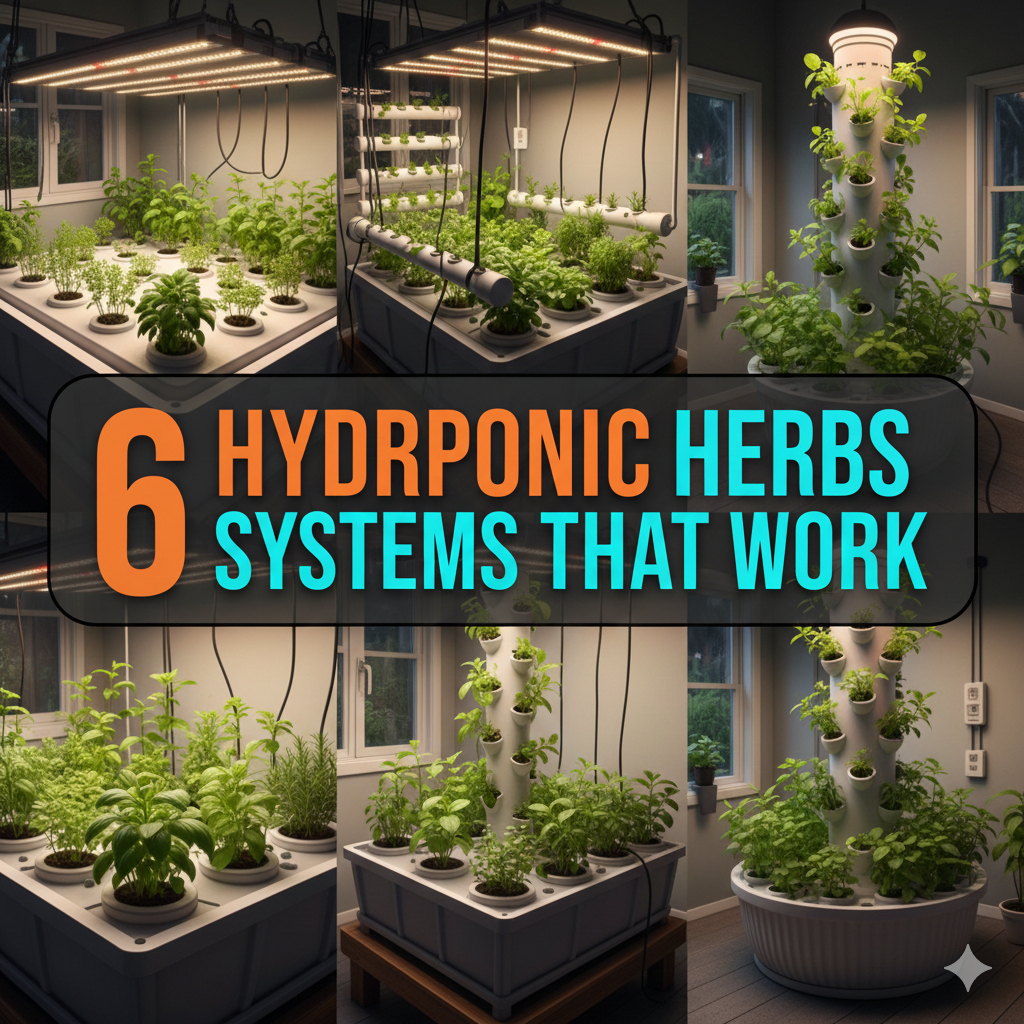
If you’re looking for an easy and satisfying way to grow fresh herbs at home, hydroponic herbs systems are the way to go. Learn 6 proven systems — how they work and the best one for your lifestyle.
It used to be that growing fresh herbs involved digging up soil, fighting off pests and praying for enough sunlight. Not anymore. Hydroponic herbs systems have revolutionized the game. You can now grow basil, mint, cilantro, thyme and more — indoors, all year round without so much as an ounce of dirt.
But here’s the thing: not all hydroponic systems are created equal. Some work better for beginners. And others are great for those looking to level up. Some use more water. Some need more space.
In plain, simple language, this guide reveals 6 proven hydroponic herbs systems. By the end, you’ll know how each one works, what’s great about it and which one could be right for you.
Let’s dig in — metaphorically speaking, of course.
Why Hydroponically Grow Herbs in the First Place?
Before diving into the systems, it’s useful to know why so many home growers and small farmers are opting for hydroponics for herbs in particular.
Herbs are among the best plants to grow using hydroponics. They grow fast. They don’t require a lot of root space. They’re light-hungry but not too demanding. And supermarket fresh herbs are pricey — if you grow them yourself, you save real money.
Here’s a quick breakdown comparing hydroponic herb growing to traditional soil growing:
| Factor | Soil Growing | Hydroponic Growing |
|---|---|---|
| Growth Speed | Standard | Up to 50% faster |
| Water Usage | High | Up to 90% less |
| Pest Risk | Higher | Much lower |
| Space Needed | More | Less (vertical options available) |
| Year-Round Growing | Weather-dependent | Yes |
| Startup Cost | Low | Medium to High |
The numbers provide a compelling argument. Faster growth, less water needed, fewer bugs, no concern about the weather. That’s why hydroponic herbs systems — in everything from kitchen countertops to commercial greenhouses — have become so popular.
What All Hydroponic Systems Have in Common
Each kind of hydroponic system — whatever you choose — bypasses soil, delivering nutrients directly to the plant roots via water. The plants grow in some sort of growing medium (like rockwool, clay pebbles or coco coir) that keeps them stable without giving them any nutrients.
The nutrients are in a balanced water-soluble solution. Roots either rest in this solution, are misted with it, or have it flow over them regularly.
The three major aspects of any hydroponic setup that you will be managing are light, pH levels, and nutrient concentration.
Now let’s dive into the 6 systems themselves.
1. Deep Water Culture — A Beginner’s Best Friend
How It Works
Deep Water Culture is as simple as hydroponics gets. The plants sit in net pots above a body of nutrient-rich water. Their roots dangle straight down into the solution. An air pump — similar to what you might use for a fish tank — keeps oxygen bubbling through the water so that roots don’t drown.
That’s it. Plants take in what they require, when it’s necessary.
Best Herbs for DWC
- Basil
- Lettuce-leaf herbs (like sorrel)
- Mint
- Chives
Why It Works So Great for Herbs
Herbs grown in DWC really thrive and put on large, dense root systems in a shorter than normal time scale. Basil in particular takes off because it likes consistent moisture and warmth — just what DWC brings.
Pros and Cons
| Pros | Cons |
|---|---|
| Very easy to set up | Roots can rot if oxygen runs low |
| Low cost | Water temperature must be monitored |
| Fast growth | Not suitable for large plants |
| Easy to monitor nutrient levels | Power outages can pose an issue |
Who Should Try It
DWC is perfect for first-timers. It doesn’t require much equipment, the setup takes under an hour, and you can visually monitor your roots growing in real time. Everything is visible and therefore easy to troubleshoot.
2. Nutrient Film Technique (NFT) — The Hardworking Efficiency
How It Works
In NFT systems, a thin layer of nutrient solution trickles down slightly sloped channels or pipes. Plant roots hang down into these channels, absorbing water and nutrients as the solution flows beneath them. The solution then drains into a reservoir at the bottom and is pumped back up to the top — it’s a continuous loop.
The key word here is “film.” The sheet of water is shallow, so roots also have plenty of aeration from the air above.
Best Herbs for NFT
- Basil
- Cilantro
- Parsley
- Oregano
- Dill
Why It’s Considered Efficient
NFT requires minimal water because it is continually recirculated. There’s minimal waste. It also scales well — adding more channels doesn’t require rebuilding the entire system.
Pros and Cons
| Pros | Cons |
|---|---|
| Water-efficient | Pump failure can quickly kill plants |
| Scalable | Channels can get clogged |
| Very good for leafy herbs | Not ideal for heavy or root crops |
| Low water volume needed | Regular monitoring required |
Who Should Try It
NFT is certainly suited for someone wishing to grow several herbs simultaneously, and who doesn’t mind giving it some daily attention. It is widely used in commercial herb farms for its efficiency and consistency of output.
3. Ebb and Flow (Flood and Drain) — The Flexible Setup
How It Works
Ebb and Flow — also known as Flood and Drain — operates in cycles. A timer controls a pump that periodically floods the tray where plants grow with nutrient solution. The solution soaks the roots. Then it flows back down into the reservoir below. This is a process that repeats several times a day.
Plants rest in a tray filled with a growing medium such as clay pebbles or rockwool. They are fed in floods, and then breathe during the draining.
Best Herbs for Ebb and Flow
- Thyme
- Rosemary
- Sage
- Lavender
- Mint
Why Growers Love the Flexibility
This system is incredibly adaptable. By adjusting the frequency of flooding, you can grow herbs with very different watering needs. Rosemary, for example, likes it drier — so you flood less frequently. Mint prefers more moisture — flood more.
Pros and Cons
| Pros | Cons |
|---|---|
| Very customizable | Timer or pump failure disrupts cycles |
| Works well with many herb types | Larger footprint than some systems |
| Easy to expand | Setup takes longer |
| Good oxygen to roots | Growing medium requires periodic cleaning |
Who Should Try It
Ebb and Flow is well suited for growers seeking control and flexibility. If you’re growing a varied herb garden that contains plants with different water preferences, this system manages it beautifully.
4. Kratky Method — The No-Power Passive System
How It Works
The Kratky Method is sometimes referred to as “set it and forget it” hydroponics. It’s a passive style of Deep Water Culture — no pump, no electricity, no air bubbling.
The trick is that plants begin with their roots barely touching the nutrient solution. As they drink the water down, an air gap forms between the surface of the solution and the bottom of the net pot. Roots spread down into the solution and the upper part of the roots takes in oxygen from the air gap.
You simply refill the water when it gets low. That’s the whole system.
Best Herbs for Kratky
- Basil
- Mint
- Chives
- Parsley
Why It’s Surprisingly Effective
For small-scale herb growing, Kratky is nearly impossible to beat for simplicity. There is no electricity cost, no pump to maintain, and no timer to set. It’s particularly popular for folks who live in areas with unreliable electricity or anyone who travels frequently.
Pros and Cons
| Pros | Cons |
|---|---|
| No electricity required | More difficult to scale |
| Extremely low cost | Nutrient solution can stagnate |
| Minimal maintenance | Not great for fast-growing large herbs |
| Great for small spaces | pH requires careful management |
Who Should Try It
Kratky is the top recommendation for total beginners or those looking to try hydroponics without spending much. All you need to start is a mason jar, a few net cups, and some nutrient solution.
5. Aeroponics — The High-Speed Growth Machine
How It Works
Aeroponics works in a wholly different way. Rather than roots sitting in water or having solution flow past them, they hang suspended in the open air inside a dark chamber. High-pressure misters regularly spray the roots with nutrient solution at timed intervals — sometimes every few minutes.
As the roots are always in air and receive only mist, they absorb maximum oxygen at almost all times. This translates to ridiculously fast growth.
Best Herbs for Aeroponics
- Basil
- Cilantro
- Parsley
- Spearmint
- Lemon balm
Why The Growth Rates Are So Impressive
Oxygen is a major driver of plant growth. Roots have a difficult time getting enough of it from soil. Most hydroponic systems provide more oxygen than soil but still have some limitation. Roots in aeroponics are oxygenated almost constantly. Research shows that aeroponic systems can grow herbs up to 3x faster than soil under the right conditions.
Pros and Cons
| Pros | Cons |
|---|---|
| Quickest growing system | Costly setup |
| Maximum oxygen to roots | Requires constant power |
| Water-efficient | Misters can clog |
| Very high yields | Steep learning curve |
Who Should Try It
Aeroponics is best suited for advanced growers or tech enthusiasts who enjoy fine-tuning details. It’s also used for commercial operations that want maximum yield. Because of the cost and complexity, it is not recommended as a first system.
6. Wicking Systems — Simple, Soil-Free, and Surprisingly Capable
How It Works
Wicking is the oldest and most passive method of hydroponics. A wick — often a cotton rope, felt, or fibrous material — bridges the plant’s growing medium with a pool of nutrient solution beneath.
Using capillary action, the solution is pulled up through the wick into the growing medium, keeping it evenly moist. No pump. No timer. No electricity.
It is similar in spirit to the Kratky Method but uses a physical wick as the delivery mechanism.
Best Herbs for Wicking
Herbs that require less water work best:
- Thyme
- Oregano
- Chives
- Basil (in small pots)
Why It’s Underrated
Most people overlook wicking systems because they look too simple. But they do very well for small herb gardens on a countertop or windowsill. They are also quiet, cheap, and demand very little maintenance.
The bottleneck is how fast water can be delivered. Wicks can only move so much solution at a time, making this system less appropriate for fast-growing or water-hungry herbs.
Pros and Cons
| Pros | Cons |
|---|---|
| Very cheap | Slow nutrient delivery |
| No electricity required | Poor option for large or thirsty plants |
| Silent operation | Wick can dry out or mold |
| Beginner-friendly | Not scalable |
Who Should Try It
Wicking systems are great for students, apartment dwellers, or anybody after a low-maintenance herb garden on a tight budget. Consider it your hydroponics training wheels — in the best way possible.
Side-by-Side: All 6 Hydroponic Herbs Systems Compared
Here’s a complete comparison to help you decide:
| System | Difficulty | Cost | Growth Speed | Best For | Power Needed |
|---|---|---|---|---|---|
| Deep Water Culture | Easy | Low | Fast | Beginners | Yes |
| NFT | Medium | Medium | Fast | Intermediate growers | Yes |
| Ebb and Flow | Medium | Medium | Moderate-Fast | Diverse herb gardens | Yes |
| Kratky | Very Easy | Very Low | Moderate | Zero-effort growers | No |
| Aeroponics | Hard | High | Very Fast | Advanced growers | Yes |
| Wicking | Very Easy | Very Low | Slow-Moderate | Apartment growers | No |
Selecting the Best Hydroponic Herbs System for Your Life
Choosing the right system boils down to three candid questions:
1. How much time can you spare for it? If you’re traveling, have a busy schedule, or simply want something low-touch — go Kratky or Wicking. If experimenting daily sounds like fun, NFT or Aeroponics will keep you well engaged.
2. What’s your budget? Kratky and Wicking cost almost nothing. DWC is affordable. NFT and Ebb and Flow fall in the middle. Aeroponics is the clear winner for most expensive entry point.
3. What herbs do you want to grow? In almost every system, basil is a superstar. Rosemary and thyme like it a little drier — Ebb and Flow is best for them. Mint grows aggressively everywhere. Cilantro grows fast and does well in NFT or DWC.
If you’re still exploring what herbs to start with, The Herb Garden is a great resource for herb growing tips, variety guides, and beginner-friendly advice to help you get started on the right foot.
General Tips That Apply to All Hydroponic Herbs Systems
Regardless of which system you choose, these tips will help your herbs thrive:
- Keep pH between 5.5 and 6.5. This is where most herbs absorb nutrients most effectively. Test weekly.
- Replace nutrient solution every 1–2 weeks. Old solution accumulates salts and disturbs balance.
- Give herbs 14–16 hours of light per day if using grow lights. Herbs are light-hungry.
- Maintain water temperature at 65–72°F (18–22°C). Warm water holds less oxygen.
- Use a high-quality nutrient solution formulated specifically for leafy plants or herbs.
- Harvest regularly. Regularly cutting herbs encourages new growth and extends plant productivity.
According to the University of Minnesota Extension, herbs generally prefer well-drained growing conditions and consistent moisture — both of which hydroponic systems provide extremely well.
FAQs About Hydroponic Herbs Systems
Q: Are there any herbs I can’t grow hydroponically? Most herbs do quite well growing hydroponically. The easiest of all are basil, mint, chives, parsley, cilantro, oregano, and thyme. Woody herbs like rosemary and lavender are a bit more demanding but definitely thrive in Ebb and Flow-type systems.
Q: Do hydroponic herbs taste different than soil-grown herbs? Many growers say hydroponic herbs taste equally good — sometimes better — because nutrients are delivered more uniformly. For example, DWC-grown basil is usually much more aromatic and flavorful than store-bought varieties.
Q: What is the cost of starting a basic hydroponic herbs system? A Kratky or Wicking setup can cost as little as $10–$30. A good DWC kit runs $50–$100. NFT and Ebb and Flow systems are priced between $100–$300. Aeroponic systems start around $200 and can easily exceed $1,000 for commercial-grade setups.
Q: Do I need sunlight for hydroponic herbs? Not necessarily. Indoor hydroponic herb gardens typically use LED grow lights. Full-spectrum LED lights are best since they are also the most energy-efficient. Natural light can also work if you’re near a south-facing window that receives 6+ hours of direct sun.
Q: How often do I need to check on my hydroponic herbs? It depends on the system. Kratky and Wicking require virtually no attention — maybe a check every few days. NFT and Aeroponics require daily monitoring since pump failures can kill plants quickly. DWC and Ebb and Flow fall somewhere in between.
Q: Can I grow hydroponic herbs organically? Yes! Organic nutrient solutions are available for hydroponic systems. Look for OMRI-listed liquid nutrients. Keep in mind that organic nutrients are harder to balance in water than synthetic ones.
Q: What’s the best hydroponic system for growing herbs indoors? For most beginners indoors, Deep Water Culture or Kratky reigns supreme every time. Both are inexpensive and work beautifully with herbs such as basil, mint, and parsley on a kitchen counter or shelf.
Wrapping It All Up
Hydroponic herbs systems aren’t a trend — they’re a smarter way to grow. From a $15 mason jar setup using the Kratky Method to a high-tech aeroponic chamber that grows herbs at extreme speed, there exists a system for your space, budget, and lifestyle.
Here’s the quick recap:
- Kratky or Wicking — Start here if you’re a complete beginner or want zero hassle
- Deep Water Culture — Best all-around beginner system with a pump
- Ebb and Flow — Best for growing different herbs with varying preferences
- NFT — Ideal for scaling up and optimizing efficiency
- Aeroponics — Ideal for speed and maximum yields when you’re ready for complexity
The most important thing? Just start. Even a jar of basil growing in nutrient solution on your windowsill counts. Once you see roots growing and taste fresh herbs sprouting in your own home, you’ll understand why hydroponic herbs systems have so many growers hooked.
Choose one, start small, and scale from there.