
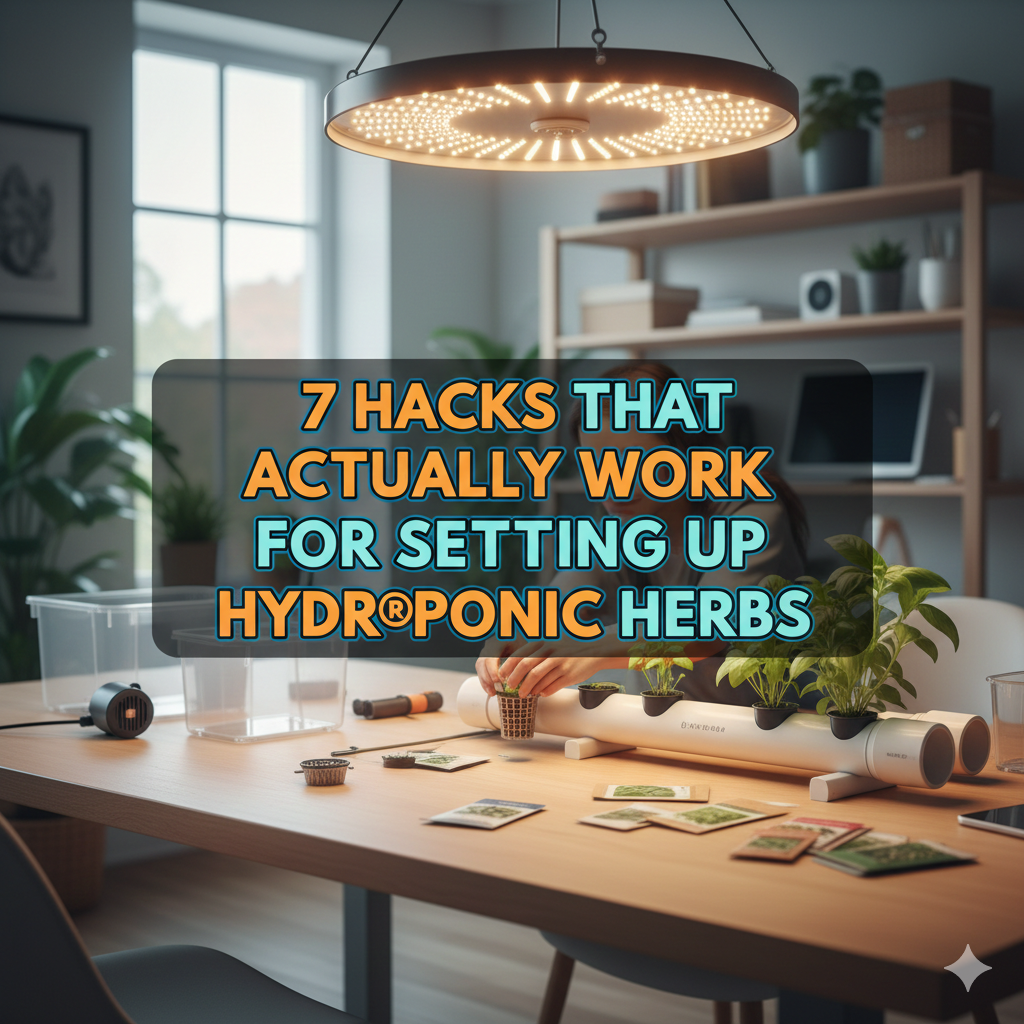
Growing fresh herbs at home has always seemed like a dream. No dirt. No weeds. No waiting for the right season.
With hydroponic herbs, that fantasy becomes your kitchen reality.
Hydroponics is simply using nutrient-rich water to grow plants instead of soil. And herbs? They are among the simplest plants to grow this way. Basil, mint, cilantro, and thyme — all flourish in water-based systems.
But here is what most beginners miss. They overthink it.
They spend hours watching videos, purchasing expensive gear, and then quit before their first harvest. This article is here to ensure that does not happen to you.
Here are 7 no-frills, budget-friendly hacks to get your at-home hydroponic herb garden started — even if you have never grown a single thing in your life.
Let’s get into it.
Why It’s Time to Try Hydroponic Herbs
Before we get to the hacks, let’s talk about why this is worth doing at all.
Grocery store herbs are usually sold in plastic packaging, overpriced, and spoil within days. A few sprigs of basil may run $3 to $5. With a hydroponic herbs setup, you grow that same basil for pennies — and it stays fresh because it is still alive.
Here is a quick side-by-side to illustrate what we mean:
| Factor | Store-Bought Herbs | Hydroponic Herbs at Home |
|---|---|---|
| Monthly Cost | $15–$30 | $2–$5 (after setup) |
| Freshness | 3–7 days | Weeks (still growing) |
| Pesticide Risk | High | Low to none |
| Availability | Seasonal | Year-round |
| Effort | Shopping trips | 5 min/day maintenance |
The numbers speak for themselves.
Now on to the fun stuff.
Hack #1 — Use a Mason Jar Instead of an Expensive Kit
You do not need a $200 hydroponic system to begin growing your herbs.
A mason jar, some net cups, and a grow light from Amazon — that is actually all you need to get started.
Why Mason Jars Work So Well
Tinted mason jars are dark, blocking light from hitting the water. This matters because light encourages algae growth in water. Algae steal nutrients from your herbs by competing with them. Not good.
The solution is simple: a brown or dark-colored mason jar will do the trick.
Here is what you need for a basic mason jar hydroponic setup:
- 1 quart-sized mason jar (dark or spray-painted black)
- 1 small net cup (that fits snugly in the jar opening)
- A growing medium (e.g. clay pebbles or rock wool)
- Water mixed with hydroponic nutrients
- A small herb seedling or seed
That is it. Total cost? Under $15 for your first one.
How to Set It Up
Fill the jar with water and add a few drops of hydroponic nutrient solution. Insert the net cup in the opening. Add your growing medium. Plant your herb. Keep the roots able to access the water but keep the crown of the plant dry.
Place it by a sunny window or under a grow light. Replace the water every 7 to 10 days.
Congratulations — you are now a hydroponic herb grower!
Hack #2 — Go Full Kratky for No-Electricity Growing
Most people think hydroponics requires pumps, timers, and electricity. The Kratky method proves them wrong.
Bernard Kratky of the University of Hawaii discovered that plants can grow hydroponically with zero electricity. No air pumps. No water pumps. Nothing.
How the Kratky Method Works
You fill a container with nutrient water. The plant roots sit in the water at first. As the plant drinks the water down, an air gap forms. The roots above the water line absorb oxygen. The roots below absorb water and nutrients.
It is arguably one of the smartest low-tech gardening tricks ever devised.
Best herbs for Kratky:
- Basil
- Mint
- Lettuce (not technically an herb, but still works great)
- Cilantro
- Chives
The Kratky Setup Steps
- Get a dark container (a 5-gallon bucket is great for multiple plants)
- Mix your nutrient solution — aim for an EC (electrical conductivity) of 1.0 to 1.6
- Fill to just below the net cup
- Place seedlings in net cups with clay pebbles
- Leave 1 to 2 inches of air gap above the water surface
- Add plain water as needed
No electricity bill. No noise. No fuss.
Hack #3 — Choose the Right Light (And Avoid the Costly Ones)
Light is where most beginners lose money.
You do not need a $150 LED grow light for a small herb setup. But you also cannot depend on a dim kitchen window alone.
The Herb Light Guide
| Herb | Light Needed Per Day | Window Okay? | Grow Light Needed? |
|---|---|---|---|
| Basil | 14–16 hours | South-facing only | Yes, recommended |
| Mint | 12–14 hours | Sometimes | Optional |
| Thyme | 12–14 hours | Sometimes | Optional |
| Cilantro | 12 hours | Often yes | Not always |
| Chives | 12 hours | Yes | Not always |
| Parsley | 14 hours | South-facing only | Recommended |
Budget Grow Light Hack
A basic 24-watt LED shop light from a hardware store costs around $20 to $30. Hang it 6 to 12 inches above your plants. Put it on a timer — 14 hours on, 10 hours off.
That is all your herbs need.
You do not need a full-spectrum, dual-band, quantum-board, red-blue-white spectrum ultra panel. Just consistent, close light for the right number of hours.
Pro tip: Aluminum foil stuck behind your setup will bounce light back at the plants, boosting growth without spending a dime.
Hack #4 — Make Your Own Nutrient Solution for Pennies
A bottle of nutrient solution may cost $15 to $30. But one bottle lasts a long time when you know how to use it properly.
Here is how you make your nutrient water perfect every single time.
The Simple Nutrient Mixing Formula
- Start with clean water (filtered or tap water left out overnight)
- Check your water’s pH — herbs prefer a pH of 5.5 to 6.5
- Add nutrients according to the instructions on the bottle (typically a few milliliters per gallon)
- Stir and measure EC with an inexpensive meter
A pH meter and EC meter together cost about $15 on Amazon. They are worth every dollar.
Signs Your Nutrient Mix Is Off
Too much nutrients:
- Yellow leaf tips
- Brown, burned-looking edges
- Stunted growth
Too little nutrients:
- Pale or yellowing leaves
- Slow growth
- Weak stems
pH too high or low:
- Yellow leaves between the veins
- Nutrient lockout (plant cannot absorb anything)
pH up and pH down solutions cost about $8 each and last several months. Keep them on hand.
Cheap pH Fix Hack
No pH solution on hand? White vinegar lowers pH. Baking soda raises it. Use very small amounts and test after each addition. Not ideal, but it gets the job done in a pinch.
Hack #5 — Maximize Space With a PVC Pipe Planter
For growing more than 2 or 3 herbs, a vertical PVC pipe system is a game-changer.
You can build one for under $30 and grow 10 to 20 herb plants in the footprint of a standard shelf.
What You Need
- 4-inch diameter PVC pipe (2 to 4 feet long)
- Drill and hole saw (2-inch holes)
- End caps for the pipe
- A small water pump and reservoir (optional for an active system)
- Net cups and growing medium
How to Build It
Cut holes in the pipe every 6 inches. These are your planting spots. Cap both ends. For a passive setup, use it like a Kratky container — fill with nutrient water, plant your herbs in the holes, and let gravity do its thing.
For an active setup, run a small tube through the pipe connected to a pump that drips nutrient water down from the top. This is called a drip system.
Vertical growing is one of the best hydroponic herbs setup tricks because it uses wall space instead of counter or floor space.
Hang it on a wall, tuck it in a closet under a grow light, or lean it against a sunny balcony wall. Instant herb wall.
Hack #6 — Propagate From Cuttings for Big Savings
Seeds take time. Cuttings are quicker and cost nothing.
Most herbs can be propagated — grown from a piece of another plant — simply by placing a stem cutting in water. Once roots develop, you can move the cutting straight into your hydroponic herbs setup.
If you want to explore more herb varieties worth growing, The Herb Garden is a great resource for inspiration and guidance on getting the most out of your herb garden.
Best Herbs to Propagate From Cuttings
| Herb | Days to Root in Water | Difficulty |
|---|---|---|
| Mint | 5–7 days | Very Easy |
| Basil | 7–14 days | Easy |
| Rosemary | 14–21 days | Moderate |
| Thyme | 10–14 days | Easy |
| Oregano | 7–10 days | Easy |
| Sage | 14–21 days | Moderate |
How to Propagate
- Cut a 4 to 6-inch stem from a healthy herb (fresh herbs from the grocery store work great for this)
- Strip the bottom 2 inches of the stem of leaves
- Stand it in a glass of clean water by a window
- Change the water every 2 days
- Once roots are 1 to 2 inches long, move to your hydroponic system
A single bunch of store-bought basil produces 5 to 10 cuttings. Every cutting turns into a full plant. That $3 grocery store bunch of herbs just became worth $30 or more.
Hack #7 — Keep Pests Away Without Chemicals
Hydroponic gardens do not have the same pest issues as soil gardens. But they are not entirely pest-free.
The most common problems in indoor hydroponic herb setups are fungus gnats, aphids, and root rot.
Here is how to deal with all three without buying expensive sprays.
Fungus Gnats
These small flies love standing water and moist growing mediums. In hydroponics, they appear when moisture lingers too long on the surface.
Fix: Allow the top layer of your growing medium to dry out slightly between waterings. Add a thin layer of sand on top of clay pebbles. Fungus gnats cannot lay eggs in dry sand.
Aphids
These tiny green or white bugs suck sap from your herb stems and leaves.
Fix: Spray leaves with a diluted dish soap solution — 1 teaspoon of soap per quart of water. Spray directly on the bugs. Repeat every 3 days for 2 weeks.
Root Rot
Root rot occurs when roots sit in stagnant, oxygen-poor water. Roots turn brown and mushy instead of white and firm.
Fix: Always keep an air gap above the water in Kratky systems. For active systems, make sure your pump runs regularly. Add a small air stone (like in a fish tank) to oxygenate the water. You can learn more about how to maintain healthy root systems in hydroponics from the University of Minnesota Extension.
The Clean Setup Rule
The number one pest prevention hack is cleanliness. Rinse your containers between grows. Change nutrient water weekly. Do not let debris sit in your system. A clean system stays healthy.
Putting It All Together — Your First Hydroponic Herb Setup Plan
Here is a simple action plan to launch your first setup this week.
Day 1: Find a mason jar or 5-gallon bucket. Spray paint it dark if needed.
Day 2: Order or buy a small bag of clay pebbles, a basic nutrient solution, and pH testing drops or a meter.
Day 3: Pick up herb cuttings at the grocery store. Start rooting them in a glass of water.
Day 4: Set up your Kratky container. Mix your nutrient solution. Test and adjust pH.
Day 5: Put your rooted cuttings (or seedlings) into net cups and place them in your system. Hang your grow light or find your sunniest window.
Days 6–7: Watch, observe, and enjoy the process.
Maintenance after setup takes only 5 to 10 minutes a day — checking water levels, watching for pests, and harvesting.
Common Mistakes to Avoid With Your Hydroponic Herbs Setup
Even simple setups can go sideways if you overlook the basics. Here are the biggest mistakes beginners make and how to avoid them.
Using clear containers: Light hits water and causes algae. Always use dark or opaque containers.
Skipping the pH test: Even with the perfect nutrients, wrong pH means plants cannot absorb anything. Test every time you mix a new solution.
Overusing the nutrient mix: More is not better. Start with the lowest recommended dose on your nutrient bottle.
Planting too many herbs in one small container: Roots need space. Crowded roots compete and stunted plants follow.
Not checking water levels often enough: In small Kratky setups, water can drop quickly in warm rooms. Check every 2 to 3 days.
FAQs About Hydroponic Herbs Setup
Q: What is the easiest herb for a beginner to grow hydroponically?
Mint is the easiest by far. It roots readily, grows fast, can forgive small errors in nutrient levels, and fills out a system in just a few weeks. If you are new to this, start with mint.
Q: How often do I need to change the water in my hydroponic herb system?
In a Kratky system, water is added to the existing solution rather than replaced completely. Do a full change every 3 to 4 weeks. For active systems, change the nutrient solution every 1 to 2 weeks to maintain freshness and prevent buildup.
Q: Do hydroponic herbs taste the same as soil-grown herbs?
Yes — and many people say they taste better. Hydroponic basil, for example, tends to be more aromatic and flavorful than store-bought because it is harvested fresh. The flavor comes from the plant’s oils, which develop fully when the plant is healthy and fresh.
Q: Can I use tap water for my hydroponic herb setup?
Yes, but leave it out overnight first. This allows chlorine to evaporate. If your tap water is very hard (high mineral content), it can affect pH and nutrient balance. In that case, filtered water is a better option.
Q: What does it cost to set up a basic hydroponic herb system at home?
A basic mason jar Kratky system can be done for as little as $15 to $20 total. A more elaborate setup with a grow light, multiple containers, and a nutrient kit costs $50 to $80. Either way, it pays for itself within a few weeks of harvests.
Q: Can I grow hydroponic herbs without a grow light?
Yes, if you have a south-facing window that receives 6 to 8 hours of direct sunlight each day. But most indoor windows do not provide enough consistent light year-round. A basic grow light for around $20 makes a huge difference in plant health and harvest size.
Q: How long before I can harvest my hydroponic herbs?
Most herbs are ready to harvest in 3 to 4 weeks from rooted cuttings. From seed, expect 6 to 8 weeks. The Kratky method with cuttings is the quickest route to your first harvest.
Final Thoughts
A hydroponic herbs setup is one of the most fulfilling and practical additions you can make to your home.
You save money. You eat fresher food. You reduce plastic waste. And truthfully — there is something really satisfying about walking to your kitchen counter and clipping fresh basil for dinner.
The 7 hacks in this article are all you need to get started today. You do not need expensive equipment. You do not need gardening experience. You do not need a big space.
Start small. Start with mint or basil in a mason jar. Learn the basics. Then scale up when you are ready.
Your first hydroponic herb harvest is closer than you think.