
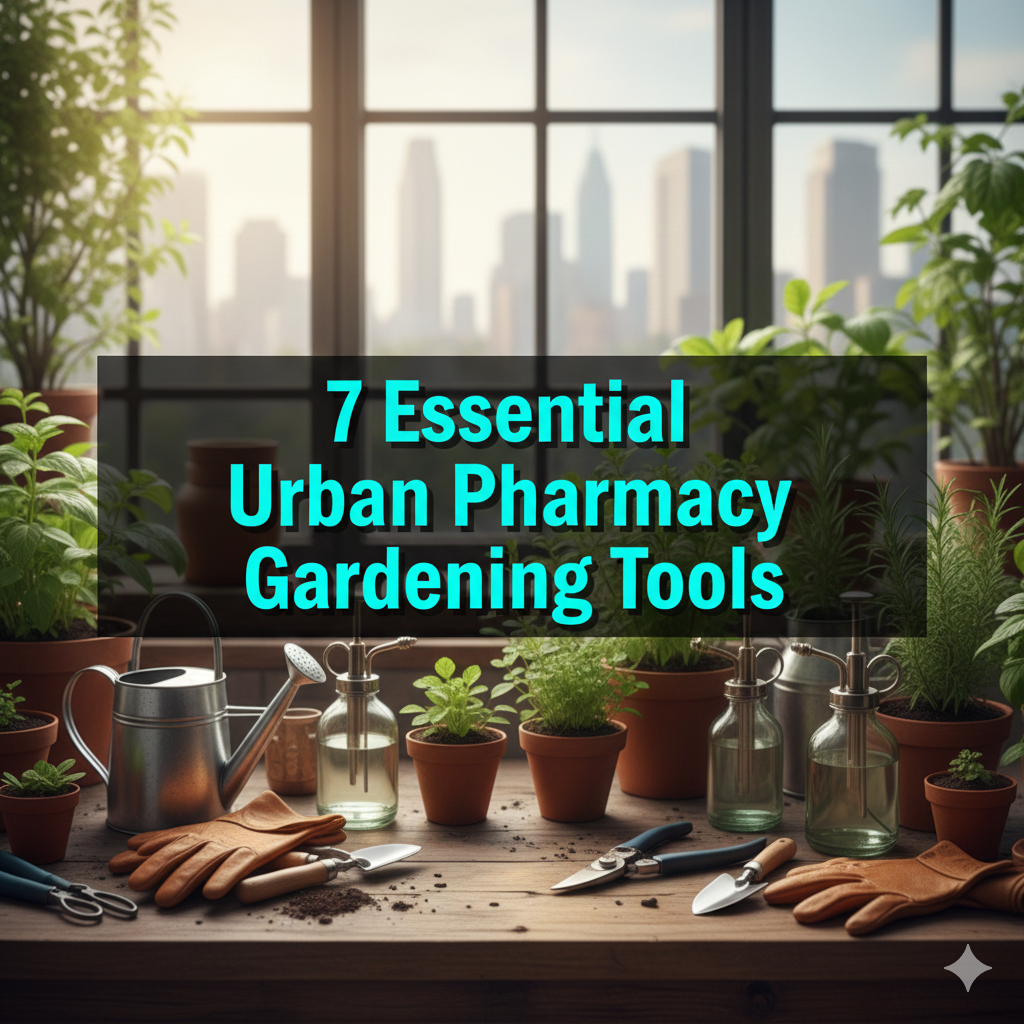
You don’t need a sprawling backyard to grow your own medicinal herbs. It doesn’t take much: a balcony, a windowsill, or even just a small rooftop space. But the right tools are a game changer.
Pharmacy gardening in cities is on the rise. More city dwellers are converting small spaces into green medicine cabinets. From lavender for stress relief to peppermint for digestion, people want to be able to trust their herbs. Herbs they grew themselves.
But without the appropriate tools, even the most excited beginner may find himself struggling. Plants die. Soil dries out. Roots rot. It gets frustrating fast.
This guide walks you through the 7 essential urban pharmacy gardening tools. They’re all practical, affordable, and ideal for cramped urban quarters. Whether you’re a beginner or taking your herb garden to the next level, this list has you covered.
Why Urban Pharmacy Gardening Is Exploding Right Now
Urban living often meant no access to nature — at all. That’s changing. Fast.
In urban areas, home herb gardening grew by more than 30% from 2020 to 2025. Folks want fresh, organic, medicinal plants within arm’s reach. They want to have control over what goes in their remedies.
Urban pharmacy gardening merges ancient herbalism with innovative small-scale cultivation. It’s practical. It’s empowering. It all begins with having the right gear.
If you’re looking for inspiration and guidance on growing medicinal herbs at home, The Herb Garden is a fantastic resource packed with tips, plant profiles, and growing guides for every level of gardener.
What Qualifies a Tool as “Essential” for Growing Medicinal Herbs?
Not every garden tool is meant for a city herb setup. A full-size spade? Useless on a balcony. A massive watering can? Too heavy and clunky.
Three common traits of essential urban pharmacy gardening tools are:
- Small footprint — does not crowd the area
- Multipurpose use — does multiple things well
- Herb-specific function — enables medicinal plants to flourish specifically
Keeping those standards in mind, here are the seven tools you really need.
Tool #1 — The Handheld Soil Trowel (Your Go-To Tool)
If you purchase one tool, make it a solid handheld trowel. This pint-sized, scoop-shaped tool is the backbone of any urban herb garden.
You’ll use it for:
- Potting up seedlings from starter trays
- Combining soil and compost for containers
- Removing dead plant matter without disturbing roots
- Checking soil depth when planting bulbs or root herbs
What to Consider When Choosing a Good Trowel
Not all trowels are equal. Cheap plastic ones snap quickly. Thin metal ones bend under pressure.
Look for these features:
| Feature | Why It Matters |
|---|---|
| Stainless steel blade | Prevents rust from frequent watering |
| Ergonomic rubber grip | Alleviates hand strain in extended use |
| Depth measurement markings | Ensures seeds are planted at the right depth |
| Narrow blade design | Moves easily through small containers and tight spaces |
A decent trowel runs about $10–$25 and lasts for years. It is the best single investment for any urban pharmacy gardener.
Herbs to Grow With a Trowel
Certain herbs, such as chamomile, valerian, and echinacea, require a particular planting depth. Markings on a trowel ensure you get it right each time. Too shallow and roots get exposed. Too deep and sprouts can’t push through.
Tool #2 — A Quality Moisture Meter (Stop Guessing, Start Knowing)
Overwatering kills more herb plants than anything else. It’s the number one mistake beginners make. And it’s totally preventable with a moisture meter.
This inexpensive device plugs into your soil and provides you with a reading. Dry, moist, or wet. That’s it. No guessing. No poking your finger into the dirt and wondering.
Why Medicinal Herbs Need Precise Watering
Medicinal herbs are not ordinary garden vegetables. Many of them come from regions with specific rainfall patterns.
- Lavender originates from the dry Mediterranean. It wants lean, dry conditions.
- Holy basil (Tulsi) enjoys consistent moisture but does not want waterlogged roots.
- Ashwagandha prefers its soil to be more on the dry side between waterings.
Without a moisture meter, you’re shooting in the dark. With one, you know exactly when to water and when to hold off.
Types of Moisture Meters
| Type | Best For | Price Range |
|---|---|---|
| Basic analog probe | Beginners, single pots | $8–$15 |
| Digital LCD meter | Multiple containers, accuracy | $15–$35 |
| 3-in-1 meter (moisture, light, pH) | Advanced growers | $20–$45 |
The 3-in-1 has become a favorite among urban pharmacy gardeners because it also monitors light levels — an important detail when you’re growing herbs near windows or under grow lights.
Tool #3 — Compact Pruning Snips (Small Tool, Big Difference)
Pruning isn’t simply for aesthetic upkeep. With medicinal herbs, the way you prune directly impacts the potency of your harvest.
When you do it correctly, the plant responds by growing more leaves and more of the essential oils that give herbs their medicinal value. If you don’t prune, your herbs bolt early, lose taste, and become less effective.
What Makes Pruning Snips Different From Regular Scissors?
Regular scissors crush plant stems. That squeezes the cells, slows healing, and invites disease. Pruning snips use a bypass blade design that produces a clean, precise cut. The plant promptly seals the wound and continues with healthy growth.
How to Prune Common Pharmacy Herbs
Peppermint: Snip right above a leaf node. Never take more than a third of the plant in one go.
Lemon balm: Trim off the top growth frequently to keep it from flowering. Flowers mark the end of leaf production.
Rosemary: Snip soft, new growth. Don’t prune into old woody stems — they don’t regenerate well.
St. John’s Wort: Pick flower tops still in full bloom for the greatest hypericin content.
Choosing the Right Snips
Look for:
- Stainless steel blades (stay sharper longer)
- Spring-loaded mechanism (less hand strain)
- Safety lock (very useful for small apartments)
- Total length not more than 7 inches (fits right in small tool pouches)
Expect to pay $12–$30 for a decent pair. A seasonal sharpening and they’ll last you for years.
Tool #4 — Self-Watering Planters (City Herb Growing, Automated)
This technically isn’t a hand tool — it’s a container. But it functions as a tool in your urban pharmacy gardening system. And it’s too significant to leave off this list.
Self-watering planters come with a reservoir at the bottom. Water is drawn up through the soil as needed. The plant pulls what it needs when it needs it. You fill up the reservoir every few days instead of watering daily.
The Big Benefits for Medicinal Herb Growers
Consistency: Medicinal herbs produce the best compounds when they’re not stressed. Inconsistent watering causes stress. Self-watering planters eliminate that.
Space-efficient: Many self-watering planters are stackable or hang. Perfect for balconies and windowsills.
Travel-friendly: Going away for the weekend? The reservoir keeps herbs alive without a plant sitter.
Comparing Container Options
| Planter Type | Water Reservoir | Best Herb Types | Space Needed |
|---|---|---|---|
| Self-watering window box | 1–2 liters | Basil, chives, thyme | Windowsill |
| Self-watering round pot | 0.5–1 liter | Lavender, mint, sage | Balcony railing |
| Vertical stacking planter | Shared reservoir | Mixed pharmacy herbs | Wall-mounted |
| Hanging self-watering basket | 0.5 liters | Trailing herbs, nasturtium | Ceiling hook |
Basic models cost as little as $15; premium stacking systems start at $80+. Begin with one or two and scale up as your urban pharmacy garden flourishes.
Tool #5 — A pH Testing Kit (The Secret Behind Thriving Herb Roots)
Most beginners skip pH testing. It’s a mistake that costs them entire harvests.
Soil pH measures how acidic or alkaline your growing medium is. It operates on a scale of 0 to 14. A reading of 7 is neutral. Below 7 is acidic. Above 7 is alkaline.
Why does this matter? pH controls how well plant roots absorb nutrients. Even if your soil is packed with compost and fertilizer, the wrong pH locks those nutrients out. Your herbs starve even in “rich” soil.
pH Sweet Spots for Common Pharmacy Herbs
| Herb | Ideal pH Range | Notes |
|---|---|---|
| Lavender | 6.5 – 7.5 | Slightly alkaline preferred |
| Peppermint | 6.0 – 7.0 | Neutral soil works best |
| Echinacea | 6.0 – 7.0 | Sensitive to high acidity |
| Chamomile | 5.6 – 7.5 | Very adaptable |
| Valerian | 5.5 – 7.0 | Slightly acidic is fine |
| Ashwagandha | 7.5 – 8.0 | Prefers alkaline conditions |
How to Fix pH in Container Gardens
Too acidic? Add garden lime or wood ash to raise pH. Too alkaline? Add sulfur, peat moss, or coffee grounds to lower pH.
Testing kits come mainly in two types:
- Liquid drop kits — inexpensive ($5–$10), less accurate, best for beginners
- Digital pH meters — more accurate ($15–$50), reusable, great for serious growers
Test your soil once when setting up a new container. Then retest every 3–4 months, or whenever plants seem unhealthy for no obvious reason.
Tool #6 — A Grow Light System (Unlock Year-Round Herb Growing)
For urban pharmacy gardeners, sunlight is the biggest constraint. North-facing apartments. Shaded balconies. Cloudy winter months. Natural light is often not enough.
A good grow light system fixes that. It allows you to grow medicinal herbs 12 months a year, no matter what’s going on outside your window.
According to the Royal Horticultural Society, supplemental lighting can significantly improve the growth and yield of herbs grown indoors, particularly during winter months when natural daylight hours are limited.
The Light Spectrum for Medicinal Herbs
That’s where things get interesting. Plants don’t just need “light.” They need specific wavelengths.
Blue light (400–500nm): Encourages leafy, dense growth. Best for the vegetative stage.
Red light (600–700nm): Promotes flowering and fruiting. Crucial for herbs such as St. John’s Wort and calendula.
Full-spectrum white light: Emulates natural sunlight. Best all-rounder for mixed herb setups.
Grow Light Options for City Apartments
| Type | Best For | Energy Use | Price |
|---|---|---|---|
| LED panel light | Full herb shelf setup | Very low | $30–$120 |
| Clip-on LED grow light | Single pots, windowsills | Very low | $15–$40 |
| T5 fluorescent tube | Wide shelving units | Moderate | $25–$80 |
| Smart grow light (app-controlled) | Automated herb stations | Low | $60–$200 |
A mid-range LED panel ($40–$70) is more than enough for most urban pharmacy gardeners. Set it on a timer — 14 to 16 hours of light per day for most medicinal herbs. That’s it.
Herbs That Respond Best to Grow Lights
- Tulsi (Holy Basil) — grows well under grow lights, yields abundant leaves
- Lemon balm — grows bushier and faster indoors under LED
- Calendula — flowers consistently with red-spectrum lighting
- Peppermint — spreads quickly with consistent artificial light
Tool #7 — An Herb Drying Rack (Preserve the Medicine You Grow)
Growing herbs is only half the work. Preserving them correctly is where most people fall short.
Drying herbs improperly destroys the essential oils, flavonoids, and other compounds that give medicinal herbs their value. High temperatures, poor airflow, and direct sunlight during drying all diminish quality.
A good herb drying rack safeguards your harvest. It holds herb bundles or loose leaves in a position that allows airflow from all sides. No mold. No clumping. No loss of potency.
The Right Way to Dry Pharmacy Herbs
Step 1: Pick herbs in the morning, after the dew has dried and before midday heat.
Step 2: Rinse gently and pat dry with a clean cloth.
Step 3: Loosely bundle 5–10 stems together with twine. Don’t pack them tight — air needs to circulate.
Step 4: Hang upside down on your drying rack in a dry, ventilated space away from direct sunlight.
Step 5: Check after 7–14 days. Leaves should be crispy but not crumbling.
Herb Drying Rack Options for Small Spaces
| Rack Type | Capacity | Space Required | Price |
|---|---|---|---|
| Hanging mesh drying rack | 4–8 layers | Ceiling hook only | $15–$35 |
| Wall-mounted rack with hooks | 10–20 bundles | Small wall section | $20–$50 |
| Tabletop drying screen | Loose leaves only | Flat surface | $10–$25 |
| Collapsible multi-layer rack | 6–12 layers | Folds flat when not in use | $25–$60 |
In most urban setups, a collapsible multi-layer rack is the best choice. It lies flat between harvests and expands when you need it.
Building Your Complete Urban Pharmacy Gardening Toolkit
Now that you know the 7 tools to have in your kit, here’s how to build it without breaking the bank.
Starter Kit (Budget Under $80)
| Tool | Budget Option | Estimated Cost |
|---|---|---|
| Handheld trowel | Basic stainless steel | $10 |
| Moisture meter | Analog single probe | $10 |
| Pruning snips | Entry-level bypass | $12 |
| Self-watering planter | Single window box | $15 |
| pH testing kit | Liquid drop kit | $8 |
| Grow light | Clip-on LED | $15 |
| Herb drying rack | Tabletop screen | $10 |
| Total | ~$80 |
Intermediate Kit (Budget $150–$250)
Upgrade to a digital meter, a full LED panel, stacking self-watering planters, and a quality hanging mesh drying rack. At this level of investment, you can support a serious urban pharmacy herb setup with 10–20 different plant varieties.
Advanced Kit ($300+)
Include a smart grow light with app control, a professional 3-in-1 soil meter, premium Japanese pruning snips, and a wall-mounted drying rack with hooks. This is for committed urban pharmacy gardeners producing significant amounts of medicinal herbs on a regular basis.
Best Herbs to Grow With These Tools
Here’s a handy guide to which herbs go best with your new toolkit:
| Herb | Key Medicinal Use | Difficulty | Best Tool Focus |
|---|---|---|---|
| Lavender | Anxiety, sleep | Easy | Moisture meter, pH kit |
| Peppermint | Digestion, headaches | Easy | Self-watering planter |
| Chamomile | Relaxation, skin | Easy | Trowel, drying rack |
| Lemon balm | Stress, antiviral | Easy | Grow light, snips |
| Echinacea | Immune support | Moderate | pH kit, trowel |
| Tulsi (Holy Basil) | Adaptogen, stress | Moderate | Grow light, moisture meter |
| Valerian | Sleep, anxiety | Moderate | pH kit, drying rack |
| Ashwagandha | Adaptogen, energy | Moderate | Moisture meter, pH kit |
| St. John’s Wort | Mood support | Moderate | Snips, drying rack |
| Calendula | Skin healing | Easy | Grow light, drying rack |
FAQs About Urban Pharmacy Gardening Tools
Q: Do I need all 7 tools, or can I start with fewer?
You can totally get away with only three: a trowel, a moisture meter, and pruning snips. Those cover the basics. Add others as your garden expands and budget allows.
Q: Can I use regular scissors instead of pruning snips?
You technically can, but it’s not recommended. Scissors crush the stem instead of making a clean cut. This stresses your plants over time and slows down regrowth. Good pruning snips really do make a difference in the health and yield of your plants.
Q: How frequently should I be testing soil pH?
Test when you first set up your containers. After that, test every 3–4 months, or when plants show signs of nutrient problems like yellowing leaves or stunted growth.
Q: Are grow lights expensive to run?
Modern LED grow lights are very energy efficient. A good LED panel running 14 hours a day typically costs between $5–$10 per month in electricity. That’s a small price to pay for fresh medicinal herbs year-round.
Q: How long do herbs take to dry on a drying rack?
Under good airflow conditions, most herbs take 7–14 days to dry thoroughly. Thick-stemmed herbs, such as rosemary, take longer. Thin-leaved herbs, like lemon balm, dry more quickly. Check for crispness — fully dried leaves snap cleanly rather than bend.
Q: Can self-watering planters cause root rot?
Only if the reservoir is never permitted to drain between refills. Allow the reservoir to go dry every couple of cycles. This encourages roots to grow downward in search of water, making your plants stronger and more drought-resilient.
Q: What is the best beginner herb for urban pharmacy gardening?
Peppermint is often recommended first. It grows quickly, tolerates beginner mistakes, flourishes in pots, and has clear medicinal benefits. It’s forgiving, rewarding, and gives you an instant confidence boost to grow more herbs.
Bringing It All Together
Urban pharmacy gardening is one of the most practical and gratifying hobbies a city person can develop. You grow your own medicine. You know exactly how it was made. And you have fresh herbs on hand whenever you need them.
But it all begins with the right tools.
A good trowel. A reliable moisture meter. Sharp pruning snips. Planters that water themselves, eliminating guesswork. A pH kit that shields your roots. A grow light that frees you from sunlight limitations. And a drying rack that locks in everything your herbs worked to produce.
These 7 essential urban pharmacy gardening tools are not luxury items. They’re the building blocks of a system that actually works — even in the tiniest city space.
Start with what fits your budget. Add tools as your confidence and garden grow. Within just one growing season, you’ll have a fully stocked urban pharmacy waiting for you right outside your door.
Your city balcony is about to become your best medicine cabinet.